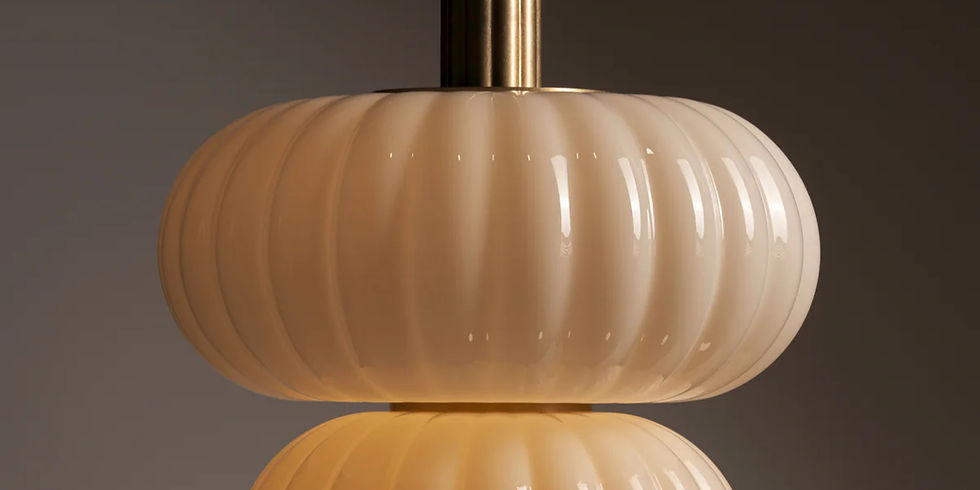

Thea Sconce
The Brief
Thea explores form as a filter for light. The project began with the challenge of designing a sconce around ceramic bodies that had yet to be built by artist Caroline Blackburn. Rather than defining a fixed form, the design had to anticipate and accommodate the organic variations of a handmade process.
The ceramic body itself controls how light is revealed, using contour, thickness, and intentional irregularity to subtly shape brightness and diffusion.
Each sconce is individually hand-built and fired, allowing the kiln and the artist’s process to play an active role in the final expression. The result is a lighting piece where no two forms are identical, emphasizing the relationship between material, process, and light.
My Role
As the industrial designer for Thea, I was responsible for developing the sconce from initial concept through design refinement and production. The project presented a unique design challenge: creating a functional lighting fixture around ceramic bodies that had an extremely high level of variability, created by artist Caroline Blackburn.
My role involved balancing aesthetic direction, functional requirements, material constraints, and manufacturability, ultimately creating a framework that allowed the artist's process to become an integral part of the final design.


Development
Using Caroline’s provided ceramic sample as a starting point, I explored and tested a range of lamping methods to determine which approach best complemented the form while providing sufficient light output. Because the final ceramic bodies had not yet been produced, I used the sample to anticipate how light would interact with the varying contours, thicknesses, and irregularities of the material. Through iterative prototyping and testing, I evaluated the quality, intensity, and distribution of light to develop a solution that felt visually integrated with the ceramic rather than competing with it. This process helped establish the lighting system while allowing the ceramic form to remain the primary expression of the sconce.


Collaboration
To ensure consistency between the hand-built ceramic bodies and the final hardware, I collaborated with Caroline to develop a series of custom jigs based on her established forming tolerances and clay shrinkage ratio, ensuring the ceramic bodies would consistently meet the dimensional requirements of the final hardware. The jig allows her to shape the ceramic while the clay is wet, establishing the critical dimensions needed for the hardware to fit, while a secondary checking jig is used once the piece has dried to verify that the final form remains within the required tolerances. I also developed a dedicated hole-cutting tool to create the precise opening on the back of each ceramic body for the mounting hardware and wiring. Together, these tools create a repeatable process that balances the handmade quality of the ceramics with the dimensional requirements of the finished sconce.


Final Form
The final sconce brings together Caroline Blackburn’s hand-built ceramic forms with a carefully integrated lighting and hardware system. Through iterative prototyping, lamping tests, and custom forming jigs, I developed a process that allowed the ceramic to remain the focal point while ensuring consistency, functionality, and ease of assembly. The result is a balance between the individuality of each handmade piece and the precision required for a finished lighting product.

